Thank you for your interest in Summit Montessori School. We understand that choosing a school is one of the most important decisions you will make for your child.
Summit provides an extraordinary education in a warm, secure, and nurturing environment. We are known for individualized learning; that is, we tailor the curriculum to each child based on his or her strengths, interests, and needs. Our innovative Montessori curriculum guides students in taking responsibility for their own work, lessons, and progress.
Summit’s faculty is extremely invested helping all children produce their very best work. Our goal is to foster independent, confident learners. Most of all, Summit creates a partnership between the school and parents to prepare children for the future.
We invite you to get to know us! Please contact us to discuss your child’s education.
Rebecca Crawford, Director of Advancement
OUR PHILOSOPHY
“…we are all witnesses to the unfolding of each human spirit, to the raising up of each child who… will have the clarity of vision to direct, shape and lead the future of human society.”
– Maria Montessori
Summit Montessori School is an independent Montessori school. We explore new methods and ways of teaching while retaining the core vision and concepts of Maria Montessori, whose revolutionary ideas have made her namesake schools all over the world so successful over the century plus since her scientific breakthroughs first began. At Summit, we respect the individual child; with teacher guidance, each student pursues a rigorous and responsive curriculum that is tailored to his or her own strengths and interests. We believe that children learn most effectively and confidently when they are active and accountable in their work. Summit adheres to the “prepared learning environment” that Dr. Montessori advocated; that is, our classrooms stimulate students to choose their own activities and work at their own pace. As a Montessori school, we adhere to the idea that children learn best by first exploring the concrete and then moving to the abstract. Our faculty teaches to the highest standards – every child works to their maximum potential – even as we make it a point to attend to each student’s individual needs.
Our curriculum is based upon the integration of subjects which are meaningfully connected.
Classrooms are designed with developmentally appropriate multi-sensory materials and resources to address each scientifically recognized developmental stage: 18 months-3 years old, 3-6 years old, 6-9 years old, and 9-12 years old.
Concentration and comprehension are facilitated as students work in uninterrupted blocks of time.
Multi-sensory learning plays an important role by optimizing visual, kinesthetic, auditory, and tactile experiences.
Social, emotional, and interpersonal skill development is integrated into the curriculum in addition to experiences that foster physical, creative, and leadership abilities.
Resources and lessons are designed to stimulate student engagement in active learning.
Mathematical skills and curiosity are fostered through the use of brilliantly designed manipulative materials.
During the elementary years the interdisciplinary cultural curriculum synergistically interweaves the fields of history, science, geography, and language arts.
Music, art, and athletic activities are integrated with academics.
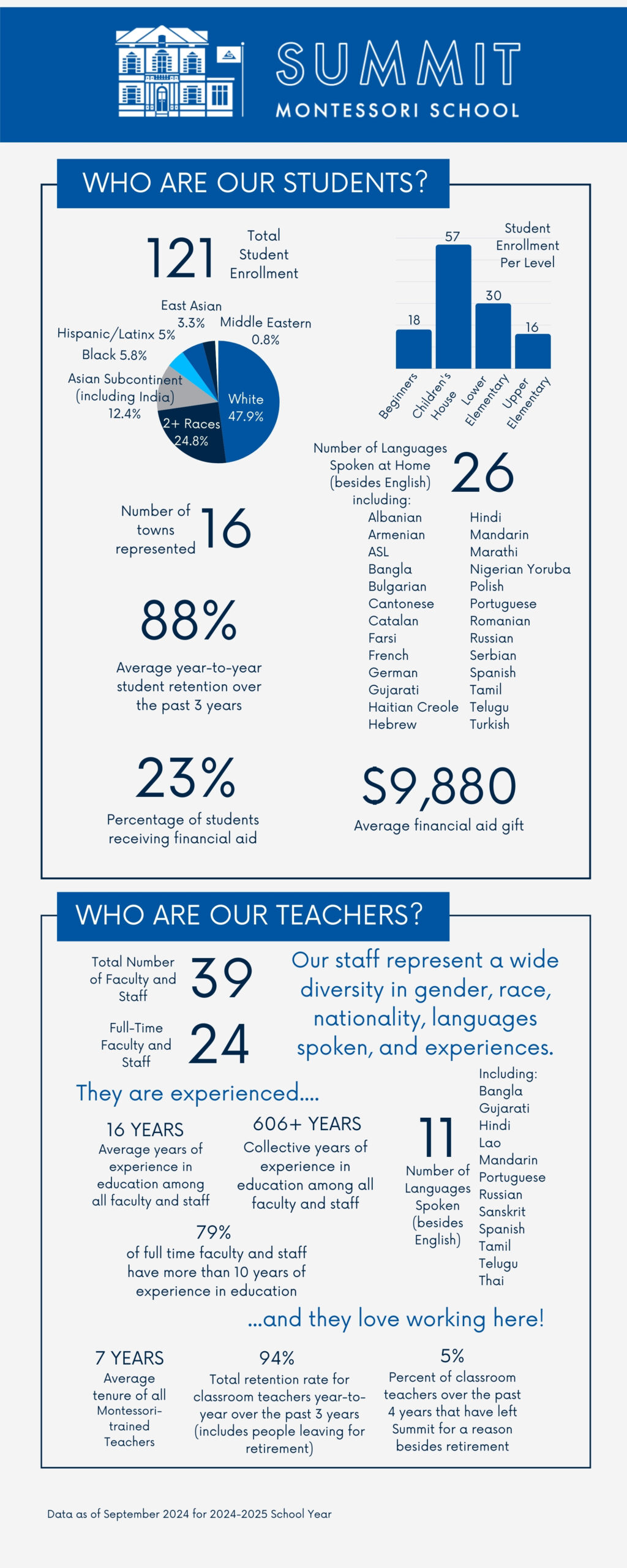
Student to Teacher ratios are set to be no more than:
- 4:1 in the Beginners classrooms
- 10:1 in the Children’s House classrooms
- Approx. 12:1 in the Lower and Upper Elementary classrooms
Students work individually and in collaboration with one another in supportive classroom environments.
OUR OUTCOMES
Over many years, we have sought out anecdotal data about outcomes of Montessori education from Montessori alums from this and other schools. What our grads tell us is that they feel well prepared for next schools; that they are confident problem solvers and social human beings; they have strong academic skills; they know how to go after their own learning; they are often sought after and admired for their leadership qualities; and they know how to organize themselves and their tasks. To a person, when quizzed about unfamiliar aspects of new schools, such as intense homework or standardized testing, they say something like, “You just organize yourself and you get it done.” Or, “Tests aren’t so hard. They just tell you what material to study, and you do it.”
But what does the research tell us about outcomes of Montessori education? In fact, there are a few recent studies that indicate very positive long-term outcomes of Montessori education. One of them, printed in the New York Times in 2019 and again in 2020, refers to a study that was completed in an urban school district in a Montessori public school program over the course of three years. The study was conducted by Dr. Angeline Lillard, developmental psychologist at the University of VA. Dr. Lillard and her colleagues compared educational outcomes among 141 preschoolers who had been randomly chosen via lottery to attend either a Montessori preschool or a traditional preschool. The two groups weren’t academically any different when they started school, but by the end of the three-year study, the kids who had gone through Montessori preschools were more academically advanced and had better
social skills than those who went to a traditional school. The Montessori students also reported enjoying school more.
To connect with the NY Times article and a summary of the research, click here.
Another longitudinal study was conducted in the South Carolina public schools, which has 7,402 students enrolled in 45 Montessori schools in 24 districts. For the impact study, researchers matched Montessori students to non-Montessori students with the same demographics and similar baseline academic performance. These matched analyses provided evidence that Montessori students experienced greater achievement growth in ELA (language studies), math, and social studies. Further, the benefits of Montessori extend beyond standardized test scores, as Montessori students also demonstrated better school attendance and behavior. The results for affective outcomes were mixed, but Montessori students had higher levels of creativity and executive function in some years of the evaluation. Click here to find an executive summary of the survey.
It is worth noting that both studies mention the significance of the interpretation of Montessori in selected schools. “Montessori” is a brand in the public domain, and there can be a wide range of interpretations. “High fidelity” Montessori schools, which produced the most significant results for students, were defined as schools that include core elements of Montessori practice, including mixed age groupings, long uninterrupted work cycles, a full range of Montessori materials, and fully credentialed teachers in all classrooms. Montessori schools that are accredited by either the American Montessori Society, as Summit Montessori School is, or the Association Montessori Internationale are considered to be “high fidelity.”